
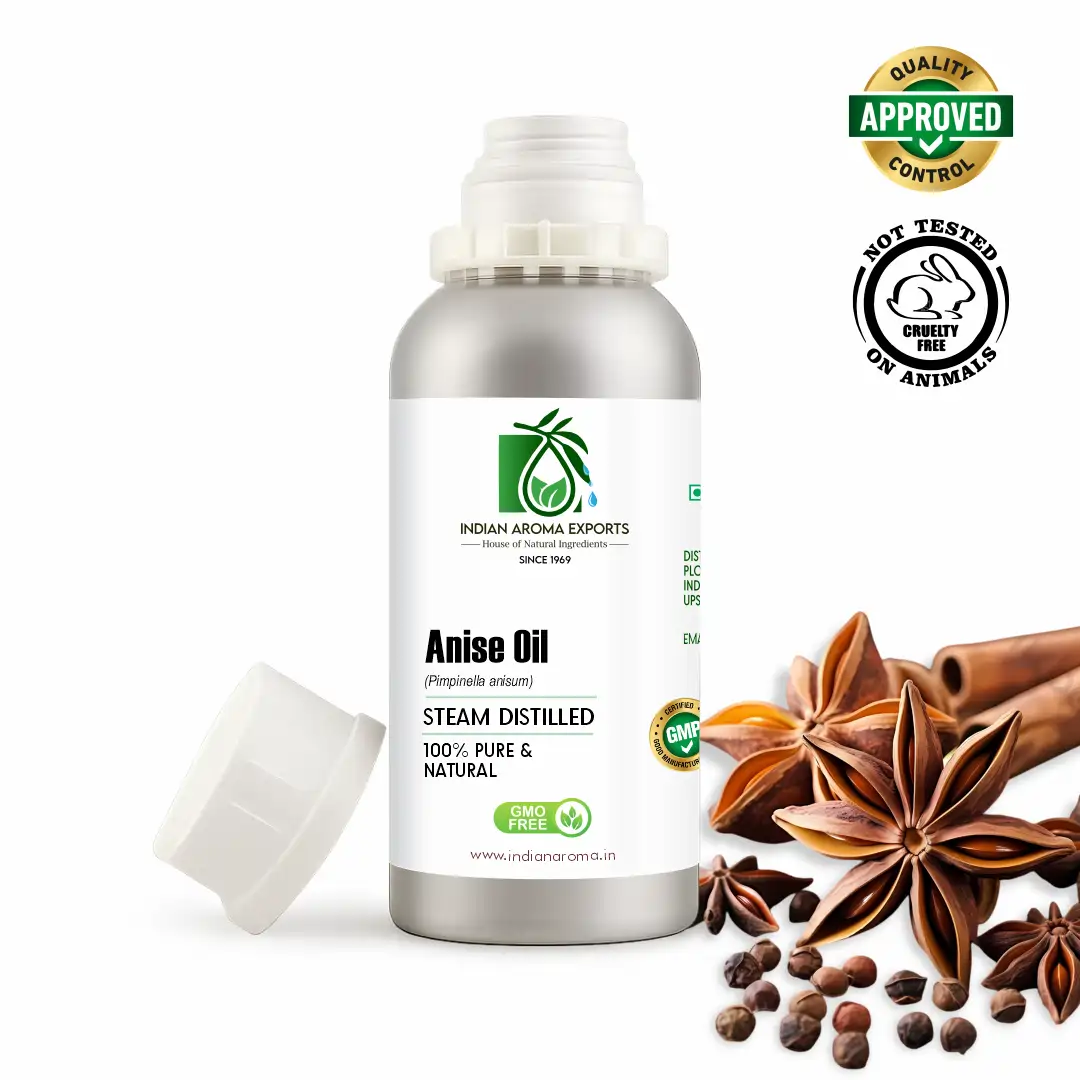

ANISE ESSENTIAL OIL BULK SUPPLIER (PIMPINELLA ANISUM )
Anise or aniseed is a tender annual, growing to about 60cm (2 ft) high, belonging to the same family as parsley and fennel. It is sometimes known as sweet cumin. its leaves are feathery, rather like coriander, and its yellowish-white flowers set to pale brown, ribbed and hairy fruit seeds which taste like liquorice.
Anise plant originates from the orient but, like most herbs, grows both in the wild and cultivated state around the mediterranean and especially in Egypt and India. It is cultivated in Spain, France and Russia. It can be cultivated further north, but it rarely sets seed.
Anise was introduced to northern Europe by the romans, and early settlers took it to North America. It was used by the romans as a digestive – in a cake eaten after meals containing other digestive seeds such as cumin and fennel – and by the ancient egyptians to help digestion of their millet and barley breads.
ANISE OIL IS DISTILLED FROM THE SEED FRUITS. IT SMELLS SWEET AND VERY CHARACTERISTIC, A LITTLE LIKE FENNEL. IT IS COLOURLESS OR A VERY PALE YELLOW.
MAIN CONSTITUENTS ANISE ESSENTIAL :
Anethole forms 80 – 90 per cent of the oil shared with a little aldehyde, anisic acid and methyl chavicol. It is often found falsified by essential oils of fennel or caraway.
USES OF ANISE OIL
IN ILLNESS
◉Anise can be very successful in treating pmt and menopausal symp¬toms, particularly in counteracting retention of fluid.
◉Make a tisane by boiling 10 ml (2 tsp) anise seeds in 600 ml (1 pint) water for 3 minutes the main property of anise is digestive.
◉The tisane helps indigestion due to anxiety and nervousness, and nervous palpitations, relieving breathing and promoting relaxation after a meal.
◉Drinking the tisane – or chewing seeds very slowly, as they do in India ¬can prevent hiccoughs and flatulence. a few deep breaths and a few minutes’ relaxation help as well. (see also appetite, loss of, colic, and dysmenorrhoea.)
IN COOKERY
◉Anise seeds can be cooked in breads, cakes and biscuits, in fish dishes, soups and curries, and some European dessert and fruit dishes.
◉They flavour confectionery such as dragees in France, and a solitary seed was once the centre of the much-loved aniseed ball.
HOW IS ANISE OIL USED IN INDUSTRIES
◉Anise oil, under strict control is used to scent pharmaceutical products such as toothpastes, mouth washes and syrups.
◉ In veterinary practice, seeds have been fed to cows as this apparently helps the production of milk (which has a faint aniseed flavour).
◉Anise eeds, crushed or whole, can scent pot-pourris, and other household pomanders.
 Botonical Name Botonical Name |
: |
Illicium verum
|
|
CAS # |
: |
8007-70-3
|
|
Country of Origin |
: |
China
|
|
Color & Odor
|
: |
Colorless to pale yellow liquid @22C with Licorice odor
|
|
Solubility |
: |
Insoluble in water, soluble in alcohol and oils
|
|
F.E.M.A. # |
: |
2096
|
|
Specific Gravity |
: |
0.978 @ 72°F
|
|
Optical Rotation |
: |
0.5
|
|
Refractive Index |
: |
1.5546 @ 72°F
|
|
Flash Point |
: |
182 °F
|
|
Major Constituents |
: |
Anethole
|
|
Extraction Method |
: |
Steam Distillation
|
Reviews
There are no reviews yet.